Hamstring Stretches for Seniors: Safe PNF Technique Guide
By Doug Jones
Q: How do PNF hamstring stretches help older adults?
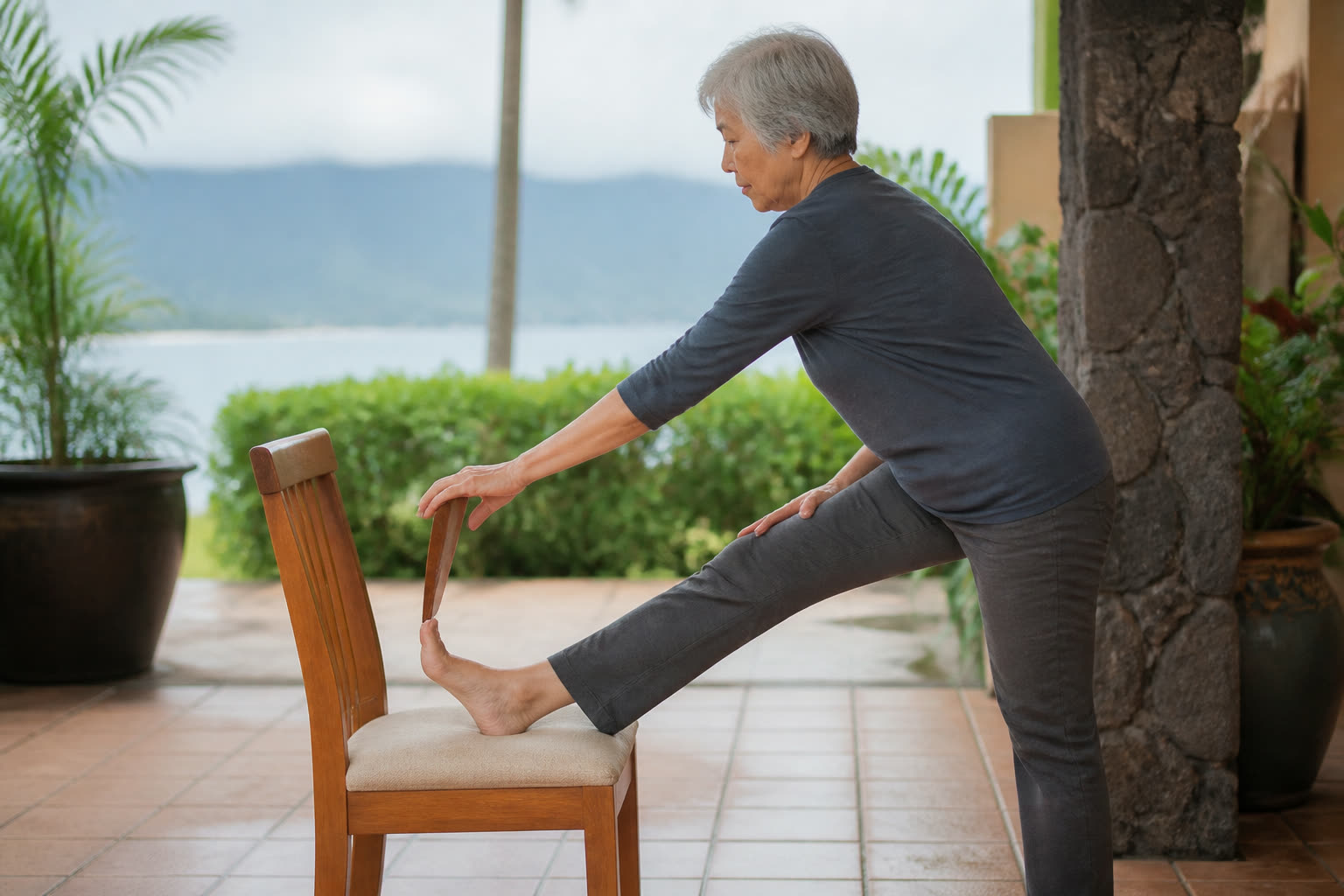
A: PNF hamstring stretches temporarily inhibit muscle contraction, allowing older adults to safely extend range of motion without straining tight tendons.
What's In This Article
- Doug's original column: Super Stretching #3
- Incorporating PNF Stretching for Seniors Safely
- Simple Senior Flexibility Exercises for Better Daily Movement
- Relieving Tight Hamstrings in Elderly Adults at Home
- FAQ: the questions I get asked most
Aloha! Finding safe, practical hamstring stretches for seniors is one of the best things you can do to keep your lower back happy and your legs moving freely as the years roll by.
In this classic column from my time writing on Kaua'i, I share a simple technique called Eccentrics in Stretching—a gentle, 7-7-7 routine that creates noticeable flexibility without any sudden jerking or forcing.
Take a quiet moment to read through the column below, make sure your muscles are warm before you start, and let's get those legs feeling light and relaxed today.
Start free at Super7System.com, or take the free fitness sampler and see the full program details.
Original Column: Super Stretching #3
My previous two columns covered the general benefits of flexibility and the specific advantages of Eccentrics in Stretching, aka “proprioceptive neuromuscular facilitation.” If you need to catch up, all of my columns are available at the website listed below.
Today, I will give you my quickest explanation of the fastest way to flexibility. While this phenomenal stretching phenomenon can be applied to every muscle, let’s take a look at one of the most problematic… the hamstrings.
If you play along, prepare to be amazed! However, always warm up and work out first; never stretch a cold muscle.
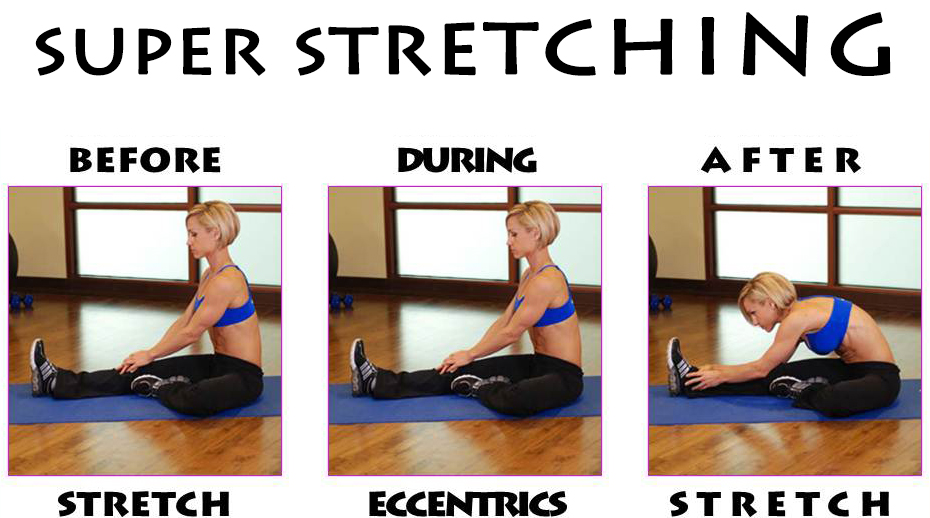
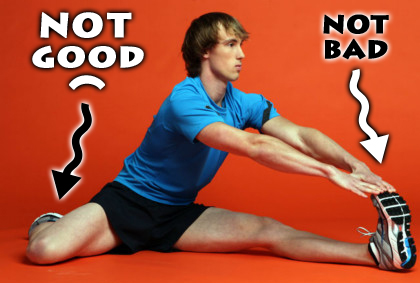
1. For this particular example, sit down (on a bench, bed, or floor) with one leg straight and the knee of the other leg comfortably bent. We will focus on increasing the range of motion of your straight leg’s hamstring muscles on the back of your thigh (semimembranosus, semitendinosus, and biceps femoris).
2. Slowly move into the fully-stretched position by gradually leaning your entire upper body forward (not just your head). It may be easier for you to hold onto your leg and to use your arms to help pull yourself towards your straight leg. As the muscles relax, you should be able to gradually deepen the stretch. Hold the final stretched position for at least 7 seconds.
3. Now, with your hamstring muscles fully-stretched, hold onto your leg with both hands to lock yourself into this position. Then, while remaining completely motionless, slowly and progressively push down with your straight leg and foot (while breathing out), as if you are trying to drive your heel into the floor (or bed or bench). Though attempting to move your foot toward the ground, you actually DO NOT MOVE your body whatsoever during the contraction. This statically-stretched contraction process is called “Eccentrics in Stretching,” which you will continue to push and hold for an additional 7 seconds.
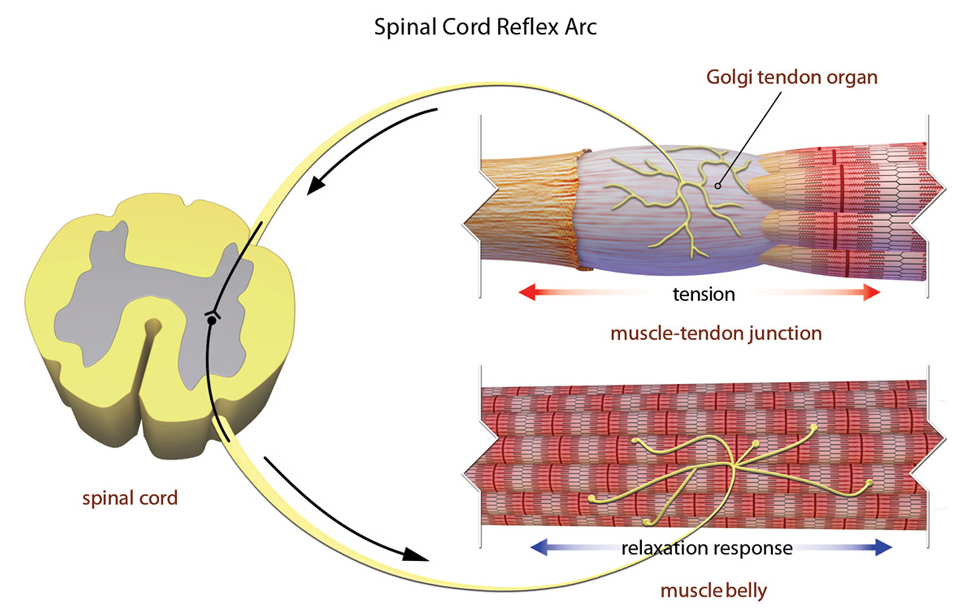
4. Onlookers should not be able to tell that you are doing anything other than a static (motionless) stretch. As you exhale, you are relaxed everywhere… except for your hamstring muscles, which are isometrically contracting from a fully-stretched position. You should definitely feel an increase in tension in the back of your thigh.
5. After you have held this contraction for 7 seconds, GRADUALLY RELAX those contracted fibers, while maintaining the EXACT same position throughout. You shouldn’t move AT ALL during this entire stretch-contract-relax process.
6. This contraction of a few muscle fibers in the hamstrings actually increases the elongation of the other muscle fibers in the hamstrings. It moves the fibers away from the center of the muscle and IMMEDIATELY increases the flexibility of that muscle. The effects of Eccentrics in Stretching are incredibly instantaneous and how his works within the body is magnificently miraculous. 7. Once you are completely relaxed and no longer contracting, be prepared to be amazed. You should now be able to continue to increase the distance of your original stretch… typically moving your upper body towards your leg much further than initially. You should be able to deepen the stretch to a much greater extent than before the 7-second contraction. Then, hold this new stretched position for 7 seconds before slowly exiting the stretch. It is VERY important to exit all stretches gradually and carefully. You can repeat this entire process another time or two. Then, of course, you need to do likewise with the other leg.
Eccentrics in Stretching causes your muscles to be temporarily, and eventually permanently, stretched “off- center.” All you have to do is statically stretch the muscle for 7 seconds, perform an “eccentrically stretched contraction” for 7 seconds, deepen the stretch for another 7 seconds… and then slowly release out of it. 7-7-7 for each muscle and you’re good to go.
Whether performed between each exercise or at the end of every workout, Eccentrics in Stretching is as time- efficient as it is productive. For more training tricks on Strength, Stamina, Stretching, and Sustenance, you can access all of my Garden Island Newspaper columns via my website below.
I look forward to hearing your questions and answering all of them in columns to come.
Ready to put your hamstring flexibility to work? Try SUPER 7 FREE for a Smart-Simple-Speedy-Safe daily starting point: no gym, no equipment, no downloads - just open and go.
In Health & With Hope,
Doug :-)
Incorporating PNF Stretching for Seniors Safely
Proprioceptive neuromuscular facilitation, or PNF stretching for seniors, sounds a bit clinical, but the practical idea behind it is wonderfully simple. When you contract a muscle while it is already stretched, you give your nervous system permission to let those muscle fibers let go. This helps you gain quiet range of motion without straining your joints or pulling on delicate tendon attachments.
Safety is always our priority here on the island. When trying PNF techniques at home, keep these practical guidelines in mind:
- Never stretch a cold muscle—do a few minutes of light indoor walking or gentle ankle pumps first.
- If floor exercises are difficult to get down to, sit near the front edge of a sturdy kitchen chair with your heel resting on a low footstool or the floor.
- Keep the push gentle—exert only about twenty to thirty percent of your total effort when driving your heel down.
- Never hold your breath during the isometric hold; exhale smoothly through your mouth as you press down.
Practicing this method two or three times a week makes getting out of deep armchairs and reaching down to tie your shoes much easier on your lower body.
Simple Senior Flexibility Exercises for Better Daily Movement
Keeping your legs limber is a big piece of maintaining your daily independence. Rounding out your weekly routine with full-body senior flexibility exercises keeps your posture upright, protects your spinal discs, and allows your hips to swing naturally when you walk. Tightness in the back of your legs pulls directly on your pelvis, which often leads to that tired, aching feeling in your lower back after standing in the kitchen or working in the yard.
Here is a safe, simple way to weave balanced stretching into your daily routine:
- Morning ankle circles: Wake up your feet and lower legs while still resting comfortably in bed.
- Seated tall resets: Sit up out of your slouch, pull your shoulder blades back gently, and take three deep breaths to open your chest.
- Countertop calf lengtheners: Place your hands securely on a sturdy kitchen counter for balance, step one foot back, and press that back heel down toward the floor.
Stretching should always feel like a welcome relief, never a sharp pain. If you ever feel a pinch or sudden discomfort, stop right away and consult your doctor before trying again.
Relieving Tight Hamstrings in Elderly Adults at Home
Managing tight hamstrings in elderly adults is a very common need, especially if you spend a good portion of your day sitting in comfortable chairs. When the muscles along the back of your thighs shorten, they pull down on sit bones and flatten the natural, healthy curve of your lower spine. Over time, that stiffness can make walking feel heavy and throw off your balance.
To work on this safely from home without ever needing to get down on the floor, use a sturdy chair for support:
- Sit forward on a firm chair with both feet resting flat on the ground.
- Extend one leg straight out in front of you, placing your heel lightly on the carpet with your toes pointing up.
- Hinge forward gently from your hip joint while keeping your spine straight, rather than rounding your upper back or dropping your chin.
- Rest your hands securely on your opposite, bent knee to keep your body stable throughout the movement.
Try this simple stretch after your afternoon walk when your muscles are already warm. Small, steady efforts without any bouncing will lengthen those tight fibers gradually and comfortably over time.
For general background, see Research published on PubMed indicates PNF stretching significantly increases hamstring flexibility and range of motion in older adults..
FAQ: Questions I Get Asked Most
What are the safest hamstring stretches for seniors?
The safest hamstring stretches for seniors are performed while seated on a sturdy chair, bench, or bed rather than standing or lying on the floor. Extend one leg forward with your heel on the ground, keep your back long, and hinge gently from the hips while holding onto your legs for support. Always warm up first and avoid forcing any movement.
How often should older adults stretch their hamstrings?
Older adults can stretch their hamstrings three to five days a week, ideally after their muscles are warm from walking or light exercise. Consistency matters far more than intensity. Holding gentle stretches for twenty to thirty seconds—or using our 7-7-7 contraction method—helps build lasting flexibility in your legs without causing tissue strain.
Is PNF stretching safe for people over 60?
Yes, PNF stretching is safe for people over 60 when done gently and without forcing the muscle. By applying a soft isometric push—using only about twenty percent of your strength—you allow the muscle to relax naturally. Hold onto a solid surface, breathe steadily, and stop immediately if you feel pain.
What causes hamstring tightness as we age?
Hamstring tightness as we age is usually caused by prolonged sitting, lower overall physical activity, and changes in muscle tissue elasticity. Shortened leg muscles pull on the pelvis and lower spine, causing back stiffness. Gentle, daily supported stretching combined with light daily walking helps restore normal muscle length.

About the Author: Douglas Jones, BS, MA, CSCS
Douglas Jones earned his Master's Degree in Exercise Physiology from the University of Maryland and is a Certified Strength and Conditioning Specialist. As an Exercise Physiologist and Concierge Fitness Professional based in Kaua'i, he has helped thousands of clients in person and millions online build simple, science-based habits for strength, stamina, stretching, and sustenance.
Doug is the founder of the Super 7 System — a complete training system you can do at home in as little as 7 minutes a day.
Watch his free intro and start free at Super7System.com.
Medical disclaimer: This article is educational only and is not medical advice, diagnosis, or treatment. Stop any movement that causes pain, and check with your healthcare provider before starting new exercise or changing your diet.
Seven honest minutes at your own counter. Try Super 7 Free →