How to Prevent Strains and Sprains After 60: Guide
By Doug Jones
Q: What is the difference between strains and sprains for seniors?
A: A strain is a muscle or tendon injury from overstretching, while a sprain is a ligament injury at a joint. After 60, both usually come from doing too much too fast, so prevention is slow eccentric lowering, counter support, and every-third-day training.
What's In This Article
- Doug's original column: Strains & Sprains
- What is the difference between strains and sprains after 60?
- The safe Super 7 method to prevent both at the kitchen counter
- Why prevention matters after 60 — and how Super 7 helps
- FAQ: the questions I get asked most
Aloha from Kaua'i, and Bali Hai to you!
If you want the short version of how to prevent strains and sprains after 60, here it is: go slower on the way down, keep a hand on the counter, and train every third day instead of every day. That's it. That's the whole secret, and it costs nothing.
I see the proof every week on our Kapa'a Bike Path Walk & Talk at Super7System.com. Folks show up sidelined by a tweaked calf or a rolled ankle, and the story always starts the same way: "I felt great, so I did a little extra."
The Super 7 answer is Smart-Simple-Speedy-Safe: use support, keep the same five rules, seven honest minutes, nothing on one leg or on the floor. And remember — the difference between doing nothing and next to nothing... is EVERYTHING!
Original Column: Strains & Sprains
For most people, working out and getting in shape can occur safely and soundly. Yes, contrary to the popular expression, gain with no pain is actually possible. With that being said, all physical activities do pose at least some inherent risk.
While most injuries can be avoided by proper warm up and slow progression, strains and sprains can occur if technique is not properly monitored. Though medical attention is always suggested when problems occur, mild injuries can often be successfully treated with the fast application of one simple acronym, R.I.C.E.

When you sTrain a muscle or tendon (or sPrain a ligament), you are actually tearing the tissue a little (primary), a lot (secondary), or completely (tertiary), depending upon where it falls on the slight-to-severe scale. Although the initial tearing definitely damages the tissue, the swelling that occurs in response often causes more injury than the original incident.
It’s all about blood flow, and time is of the essence. Reducing excessive swelling to the affected area goes a long way to prevent more pain. So, it’s R.I.C.E. to the rescue:
- Rest – Ice – Compression - Elevation -

REST: With a new injury, don’t do anything that might bring more blood to the area. Even if it only hurts a little, it means that that you are probably continuing to re-injure the tissue trying to heal. Prolonging activity can delay healing, increase pain, and cause further injury by stimulating additional internal bleeding and swelling. Rest is best.
ICE: The initial application of ice soon after an injury results in the constriction of small blood vessels, assisting in the cessation of internal bleeding from injured structures. Constriction of blood vessels ultimately decreases the amount of blood that can collect around the injury, helping to prevent additional tissue strain and damage.

Use ice packs or bags or frozen vegetables for larger areas, but avoid placing them directly on the skin. Extremities might be better off being completely immersed in a bucket of ice water.
Drastic cooling of specific tissues initially stimulates additional blood flow to the iced location. This extra blood flow often causes a burning sensation that is sometimes close to unbearable. Gradually adding ice to the bucket during the submersion method definitely helps soften the blow.
After approximately 10-15 minutes, the iced body part should go numb. This is when the ice treatment really begins… and you must get to, and past, this numbing point. A total of 20-30 minutes of ice is sufficient. Also, be aware that the iced body part must also have ample time to thaw and warm before using it.
During the icing experience is a great time for you to call your doctor or trainer, if justified.

COMPRESSION: Compression decreases swelling by controlling internal bleeding and limiting the accumulation of blood and plasma near the injured site. Without compression, fluid from adjacent tissue seeps into the injury area. Surplus blood and fluid accumulating around an injury causes more swelling and retards the healing process. Elastic bandages are great, but be careful not to compress too tightly so that blood supply is impaired. Err on the side of conservative caution.

ELEVATION: Elevating the injured part above the level of your heart is another way to decrease swelling and pain at the injury site. Elevate the affected area in whatever way is most convenient. Gravity is a strong force, and you can use it to your advantage to keep additional swelling and injury at bay.
Use R.I.C.E. when necessary, but don’t rely on it exclusively. Injuries are serious and should not be treated lightly. If pain is severe or persists, contact a medical professional soon (if not sooner).
Even if you choose to not implement R.I.C.E., or just plain ice, please DO NOT HEAT, STRETCH, OR MASSAGE any tissues which have been recently injured. It might feel good to your brain, but it’s not for your body.
Heat and massage draw blood to the area and create more swelling, which further tears tissues. Yes, a Jacuzzi and hot pack relax the muscles and feel great… temporarily. Tomorrow, your body will be further inflamed and injured by the increases in blood flow and accentuated swelling.
With regard to stretching an injured area, keep in mind that strains and sprains are, by definition, overstretched tissues. Stretching and massage only further stretch what is already overstretched.
Heat, stretching, and massage can all be used in the long term. First and foremost, open your freezer and grab a big bag of RICE.
Ready to put your injury prevention to work? Try SUPER 7 FREE for a Smart-Simple-Speedy-Safe daily starting point: no gym, no equipment, no downloads - just open and go.
In Health & With Hope,
Doug :-)
What Is the Difference Between Strains and Sprains After 60?
Spelling makes this easy to remember. A sTrain has a T in it, for Tendon — a muscle or tendon that got overstretched or torn. A sPrain has a P, for the Pull at a joint — a ligament, the tough band that holds bone to bone.
Strains happen in the meaty middle: calf, hamstring, low back. Sprains happen at hinges: ankle, knee, wrist. Both are caused by speed, not by weight.
Why it's different after 60. Tendons and ligaments carry less blood than muscle, and that supply thins with the years, so repair is slower. A strain that cleared in five days at forty can linger five weeks at seventy.
That's also why these injuries matter so much. The CDC reports that about one in four adults 65 and older falls each year, and a sprained ankle or a strained back is often what starts the slide from confident to careful. The National Institute on Aging points to muscle weakness and poor balance as leading, fixable causes.
Good news: weakness is trainable. You don't prevent strains and sprains by being careful forever — you prevent them by getting strong. Start with safe leg exercises at home.
The Safe Super 7 Method to Prevent Both at the Kitchen Counter (70s, 80s Welcome)
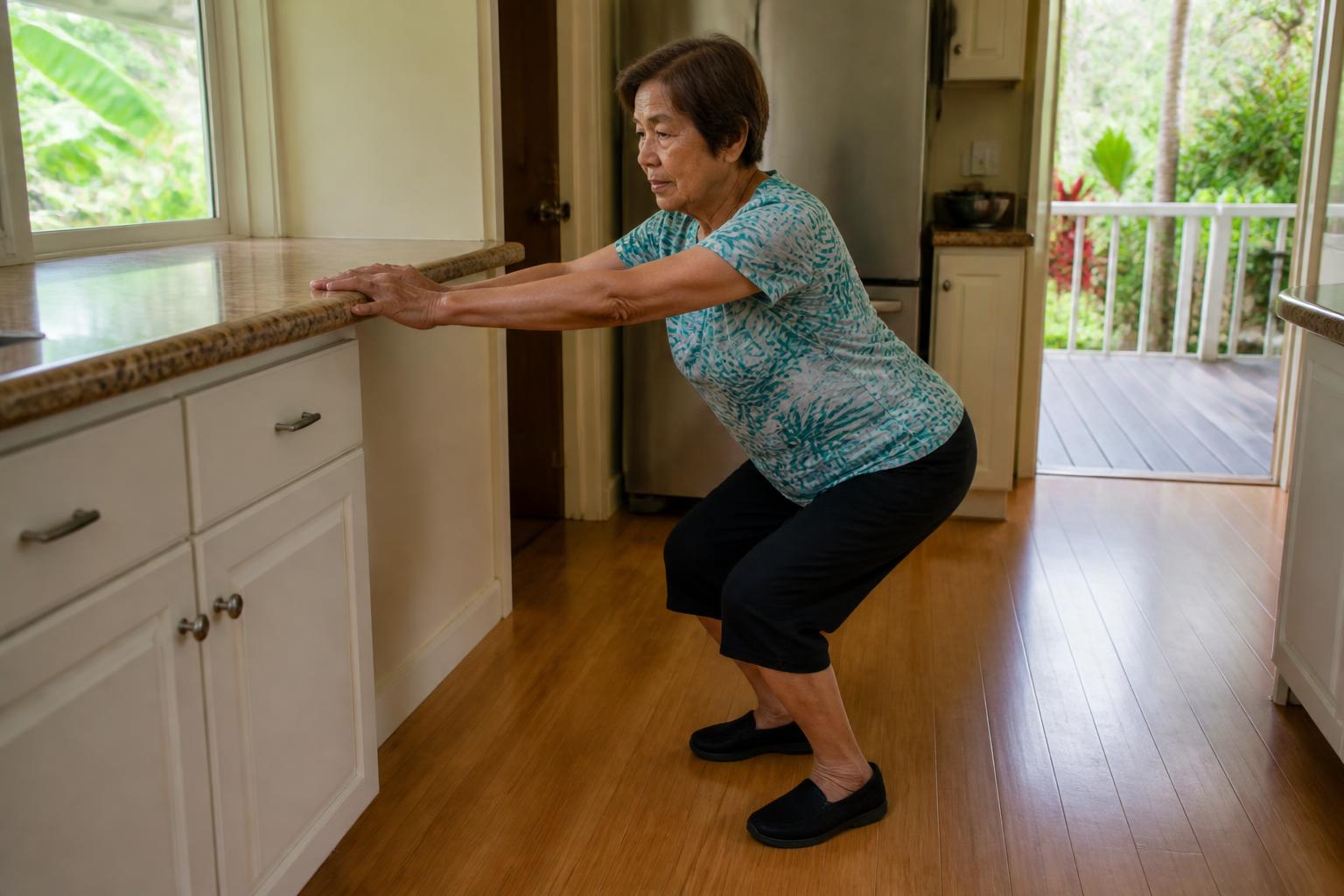
Everything below happens at a kitchen counter, both hands on it. No floor, no equipment.
- Rule 1 — Lower slowly. Up 1, down 4. One second to rise, four honest seconds to lower. That slow lowering is the eccentric half, and it's where tendons get tough. Fast, dropping reps are how strains happen.
- Rule 2 — Every third day. Monday, Thursday, Sunday. Connective tissue needs 48 to 72 hours to rebuild. Daily hard work isn't dedication, it's the most common cause of a strain I see.
- Rule 3 — Soft knees, never locked. Both hands on the counter, chair behind you. Locked knees jam a joint; the chair behind you means a miss is a sit, not a fall.
- Rule 4 — Week Zero, repeated twice. Do the easiest week two times before you move up. Your brain needs a week to learn a movement before your tendons should be asked to load it. Patients have patience.
- Rule 5 — RICE, not heat, for the first 48 hours. If something does go wrong, the column above is your instruction sheet: Rest, Ice, Compression, Elevation. No heat, no stretching, no massage on fresh tissue.
Set-up safety, every single time: a non-slip mat underfoot, closed-toe shoes with a back strap (never slides or bare feet on tile), a partner or a phone within reach, and clear floor space behind you.
If you take blood thinners, bruise easily, or have osteoporosis, stay in the smallest range that feels easy and check with your physician before adding depth or reps — thinned bone and thinned blood both change the math on a small fall.
Can't stand comfortably today? Do the same movements seated on a firm bed or bench — same four-second lowering, same every-third-day rhythm.
Why Prevention Matters After 60 — and How Super 7 Helps
Slow eccentric lowering is tendon insurance. Twelve weeks of it builds roughly 30% stronger tendons — and a stronger tendon doesn't tear when you catch your toe on the lanai step.
That's the Twin Turbo bargain: half the oxygen, double the strength. Majestic Muscles aren't for the mirror — muscle is the shock absorber that keeps an ankle from rolling and a knee from buckling. Here's why seniors need more muscle.
Seven minutes, every third day, at your own counter. That's the whole prescription. Try SUPER 7 FREE and let me walk you through the first session today.
FAQ: Questions I Get Asked Most
How do I know if it's a strain or a sprain?
Pain in the belly of a muscle that hurts when you contract it is usually a strain. Pain at a joint line that hurts under weight is usually a sprain. Either way the first 48 hours are RICE. Can't bear weight? That's a doctor visit.
How do I prevent muscle strains after 60?
Muscle strain prevention over 60 is tempo and spacing: four-second lowering, every third day, one small step up every two weeks. Warm up with a half-effort first set — a warm-up, not a stretch.
What should I do immediately after a strain?
Stop. Rest it, ice it 20 to 30 minutes past the numbing point, wrap it snugly but not tightly, and prop it above heart level. Do not heat it, stretch it, or massage it for the first two days — strains vs sprains in seniors both involve already-overstretched tissue, and stretching stretches it further.
Can seniors exercise with a previous sprain?
Usually yes. An old sprain leaves a joint less sure of itself, and the fix is strength around it. Start at Week Zero, both hands on the counter, pain-free range only.
Source: the U.S. Centers for Disease Control and Prevention keeps the national fall and injury statistics for older adults — see CDC Falls Facts.

About the Author: Douglas Jones, BS, MA, CSCS
Douglas Jones earned his Master's Degree in Exercise Physiology from the University of Maryland and is a Certified Strength and Conditioning Specialist. As an Exercise Physiologist and Concierge Fitness Professional based in Kaua'i, he has helped thousands of clients in person and millions online build simple, science-based habits for strength, stamina, stretching, and sustenance.
Doug is the founder of the Super 7 System — a complete training system you can do at home in as little as 7 minutes a day.
Watch his free intro and start free at Super7System.com.
Disclaimer: Educational only, not medical advice. If you have severe pain, rapid swelling, deformity, numbness, or an inability to bear weight, seek medical care promptly. Consult your physician before starting or changing an exercise program, especially with osteoporosis, blood thinners, or a heart condition.