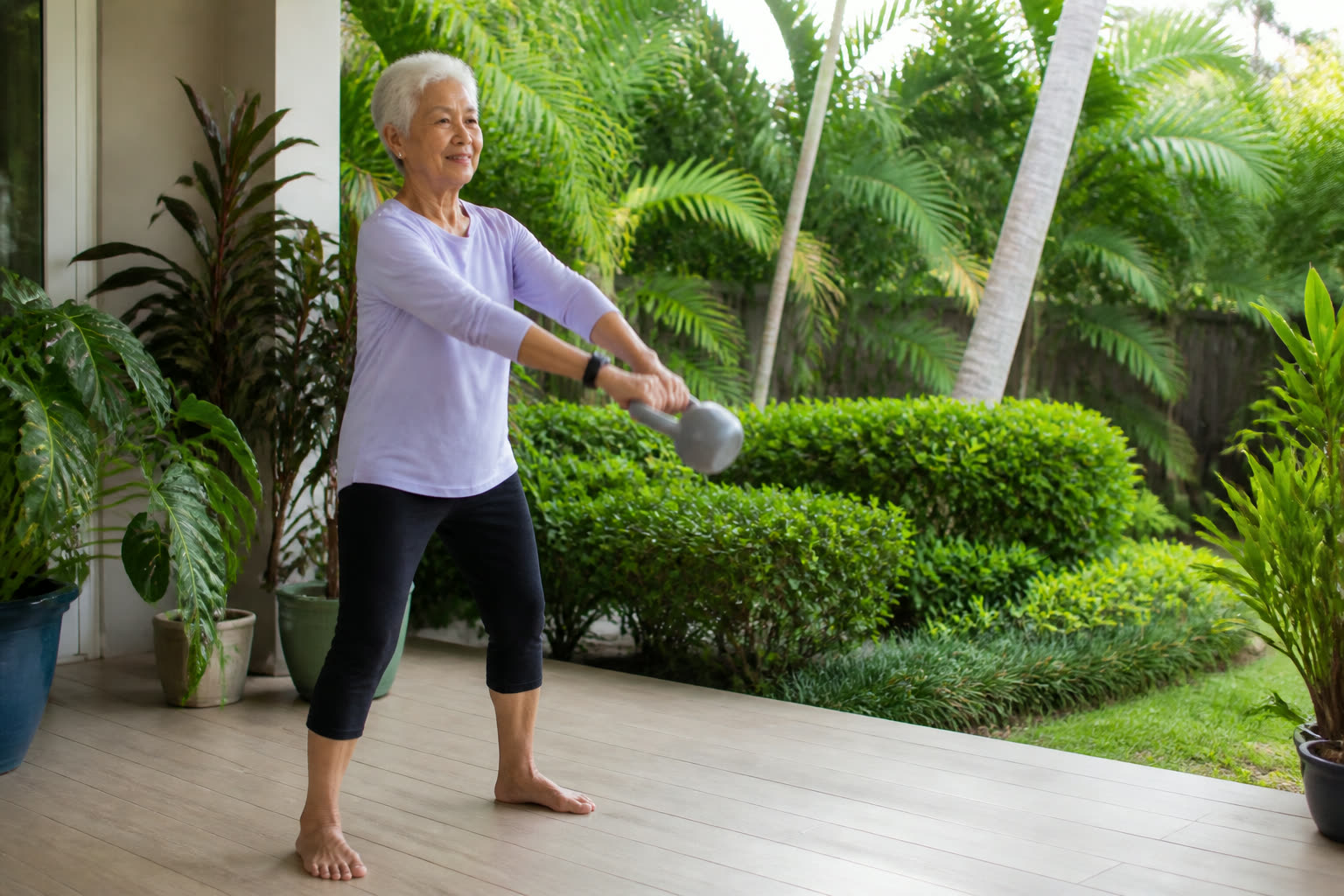
Stamina Scale For Senior Fitness: How To Optimize Effort
By Doug Jones
Q: How does the stamina scale for senior fitness regulate interval training intensity?
A: The stamina scale for senior fitness tracks perceived effort, helping older adults safely manage exertion swings, prevent premature fatigue, and maintain lasting cardiovascular conditioning goals.
What's In This Article
- Doug's original column: Why is 7 Super? Part 1: 7 Swings of Stamina
- How to Use a Perceived Exertion Scale for Older Adults
- Mastering the 7 Swings Interval Training Method
- Avoiding Cardio Workout Plateaus Seniors Often Face
- FAQ: the questions I get asked most
Aloha! When you are building cardiovascular endurance in your sixties, seventies, or beyond, using a reliable stamina scale for senior fitness helps you tune into your body without overdoing it.
Instead of relying on complicated heart rate monitors or pushing until you are gasping, listening to your internal signals gives you real-time feedback on your effort. That self-awareness is key to staying safe while building real endurance.
In the column below, we look at why working through seven balanced intervals—anchored right at that comfortable "somewhat hard" middle ground—keeps your heart and muscles healthy, safe, and strong for years to come.
Start free at Super7System.com, or take the free fitness sampler and see the full program details.
Original Column: Why is 7 Super? Part 1: 7 Swings of Stamina
WHY IS 7 SUPER? PART 1:
7 Swings of Stamina!

Aloha, and happy Fourth of July weekend to all!
For this celebratory 7th month of the year, I’m launching my first of 7 columns exploring the question: “Why 7?” For the remainder of the year, we will dig into the scientific foundations of fitness, and why 7 is superlative for strength, stamina, stretching, and sustenance.
With a physique transformation target of 2027, let’s begin with stamina, and how Super 7 training can support long-term physiological adaptation, metabolic efficiency, and sustainable conditioning.
The Super 7 Stamina Scale!
My Super 7 Stamina Scale runs from 6 to 20, where your overall feeling of exertion correlates to a given number:
- 6 = Very, Very Light...
- 13 = Somewhat Hard...
- 20 = Very, Very Hard...
This scale is not about heart rate or external measurement. It is about perceived effort… how hard the work feels in the moment. The training structure is centered around 7 swings of effort, moving above and below that central point of 13 in a controlled rhythm of rise, effort, recovery, and reset.
Now the question becomes: Why 7?
1. Dose Busters!
The body responds to exercise through a dose-response curve. Initial training intervals produce strong improvements, but over time, those gains begin to plateau while fatigue continues to rise. 7 swings sit in that efficient zone where cardiovascular and metabolic stimulus remain high without excessive wasted effort or diminishing returns.
2. Tactical Fatigues!
You pay the price for each and every hard effort, and those costs accumulate across a session. Research on repeated exertion shows that performance quality declines when interval volume gets too high for the intensity being used. 7 preserves something essential: each effort still retains quality… from start to finish.
3. Mental Metronome!
Your brain is constantly regulating exercise intensity through perceived effort signals. However, as repetitions increase, that internal calibration can begin to drift. 7 keeps the system inside a stable range where perception remains accurate, usable, and trustworthy.

4. Feasibly Fit!
While the most important variable in fitness is intensity, consistency is the cornerstone. 7 swings create a psychologically practicable structure: start, build, peak, recover, finish, reset, repeat. 7 super cycles is the middle “Goldilocks” number… the perfect fit for fitness. It feels finite, achievable, and repeatable. And that sense of completion is what drives long-term adherence.
5. Physical Integrity!
Fatigue does not just reduce performance; it changes movement quality. When repetition volume gets too high, coordination declines and compensations increase. 7 preserves enough repetition to build rhythm and conditioning without pushing most people into breakdown mechanics.
6. Super 7 Center!
The Stamina Scale runs from 6 to 20, and level 13 sits exactly in the middle… 7 from the bottom and 7 from the top. This midpoint reflects a real transition zone in perceived exertion where effort shifts from sustainable aerobic work into rising fatigue and anaerobic demand. Below 13, effort is generally sustainable. Above 13, fatigue rises disproportionately. 7 swings structured above and below this midpoint allow controlled movement around a stable anchor rather than chaotic intensity shifts.
7. The 7th Wave!

Human effort is not linear; it is cyclical. Every training session naturally forms a wave pattern, and 7 swings complete that wave cleanly. Fewer than 7 and the wave feels incomplete. More than 7 and fatigue begins to override adaptation. 7 is the point where effort and recovery stay in rhythm.
Although 7 is often recognized as a biblical number of completeness and wholeness, 7 is not a mystical number. It is a convergence point where multiple well-established principles in exercise science overlap, including physiological efficiency, fatigue behavior, neurological regulation, adherence psychology, movement integrity, threshold symmetry, and natural effort rhythm.
Too few swings and you don’t get enough training stimulus. Too many and you begin borrowing from recovery instead of building adaptation.

7 sits precisely in the middle where effort is meaningful, repeatable, and sustainable. At the center of it all is level 13… the “somewhat hard” anchor point where the body is working, but still under control.
The Super 7 System is not about doing more. It is about doing just enough, in a structure the body can understand, long enough to create physiological change. 7 swings give you that structure: simple, repeatable, and surprisingly powerful when applied consistently.
Ready to put your stamina to work? Try SUPER 7 FREE for a Smart-Simple-Speedy-Safe daily starting point: no gym, no equipment, no downloads - just open and go.
In Health & With Hope,
Doug :-)
How to Use a Perceived Exertion Scale for Older Adults
Learning to listen to your body is one of the safest habits you can build as you age. A perceived exertion scale for older adults translates how your lungs, heart, and legs feel into a clear number from 6 to 20, keeping you in complete control of your workout.
Level 6 feels like relaxing on your lanai, while level 20 is an absolute maximum effort that we avoid in home training. Your sweet spot sits around level 13—a comfortable level where your breathing is deep, your body is warm, but you can still speak a full sentence without gasping.
Here is how to check your numbers safely during a session:
- Check your breath: If you cannot catch your breath to answer a simple question, step back to a lower level immediately.
- Keep steady footing: Keep a sturdy kitchen counter or solid chair back within arm's reach while assessing how your legs feel.
- Respect joint signals: Exertion should feel like muscle work and cardiovascular depth, never sharp joint pain or dizziness.
By checking in with your internal gauge every few minutes, you gain all the stamina benefits while protecting your balance and joints.
Mastering the 7 Swings Interval Training Method
Traditional interval training often pushes people too far, leading to sore knees or heavy fatigue that ruins the rest of your week. The 7 swings interval training method works differently by keeping your efforts controlled, finite, and effective.
Instead of endless repetitions, you complete seven distinct waves of effort. You gently rise above your central anchor of level 13 for a short period, and then safely slide back down below it to catch your breath and let your heart rate settle. This rhythmic approach gives your metabolic system a clear signal to adapt without draining your reserves.
To put this into practice this week, try this simple setup:
- Warm up thoroughly: Spend five minutes walking gently in place near a wall or counter for balance.
- Structure your waves: Increase your pace or lift your knees slightly higher for 30 to 60 seconds, then slow down until your breathing normalizes.
- Count your swings: Stop after your seventh recovery wave, even if you feel like you could do more.
Stopping at seven keeps your movement patterns clean, protects your posture, and leaves you feeling energized for the rest of your day.
Avoiding Cardio Workout Plateaus Seniors Often Face
When you perform the exact same walk or exercise routine at the exact same pace every day, your body eventually adapts completely. While that consistency is wonderful, avoiding cardio workout plateaus seniors often experience requires gentle variation in your intensity.
Your body responds best to a dose-response dynamic. If the stimulus never changes, gains in stamina stall out, yet daily tiredness can still accumulate. By shifting your effort slightly above and below your baseline effort across seven brief cycles, you challenge your lungs and circulatory system just enough to trigger fresh adaptations.
Here are practical steps to keep your progress moving forward safely:
- Vary your speed: Pick a small marker on your walking route or count 20 steps at a brisk pace, then return to your normal stride.
- Listen to fatigue: If your form breaks down or your ankles feel wobbly, shorten your efforts. Quality always beats quantity.
- Prioritize recovery: Give your body at least one full day of light movement like gentle stretching between stamina sessions.
Smart training is not about working harder until you wear out; it is about giving your body the precise cue it needs to keep building lasting energy.
For general background, see CDC guide to measuring perceived exertion.
FAQ: Questions I Get Asked Most
What is a stamina scale for senior fitness?
A stamina scale for senior fitness is a simple tool, based on Borg's Rating of Perceived Exertion (RPE), ranging from 6 to 20. It helps older adults measure how hard an exercise feels based on breathing, effort, and fatigue, ensuring you stay in a safe, effective range around level 13 without needing complicated electronic monitors.
How hard should exercise feel for adults over 60?
For most active older adults, a moderate effort around level 13 on the 6 to 20 scale—often described as 'somewhat hard'—is ideal. You should feel your heart beating faster and your body warming up, but you should still be able to talk without gasping for air.
Why are short interval workouts better for active older adults?
Short intervals allow your heart and lungs to adapt without causing deep muscular exhaustion or joint irritation. By dividing your effort into distinct waves with brief recovery periods, you maintain safe posture and steady balance while building cardiovascular stamina efficiently.
How often should I practice interval stamina workouts each week?
Two to three days a week is plenty for most seniors. Leaving a day or two of light walking or stretching between sessions gives your muscles and heart adequate time to rebuild, helping you avoid plateaus and stay consistent without overtraining.

About the Author: Douglas Jones, BS, MA, CSCS
Douglas Jones earned his Master's Degree in Exercise Physiology from the University of Maryland and is a Certified Strength and Conditioning Specialist. As an Exercise Physiologist and Concierge Fitness Professional based in Kaua'i, he has helped thousands of clients in person and millions online build simple, science-based habits for strength, stamina, stretching, and sustenance.
Doug is the founder of the Super 7 System — a complete training system you can do at home in as little as 7 minutes a day.
Watch his free intro and start free at Super7System.com.
Medical disclaimer: This article is educational only and is not medical advice, diagnosis, or treatment. Stop any movement that causes pain, and check with your healthcare provider before starting new exercise or changing your diet.
Seven honest minutes at your own counter. Try Super 7 Free →