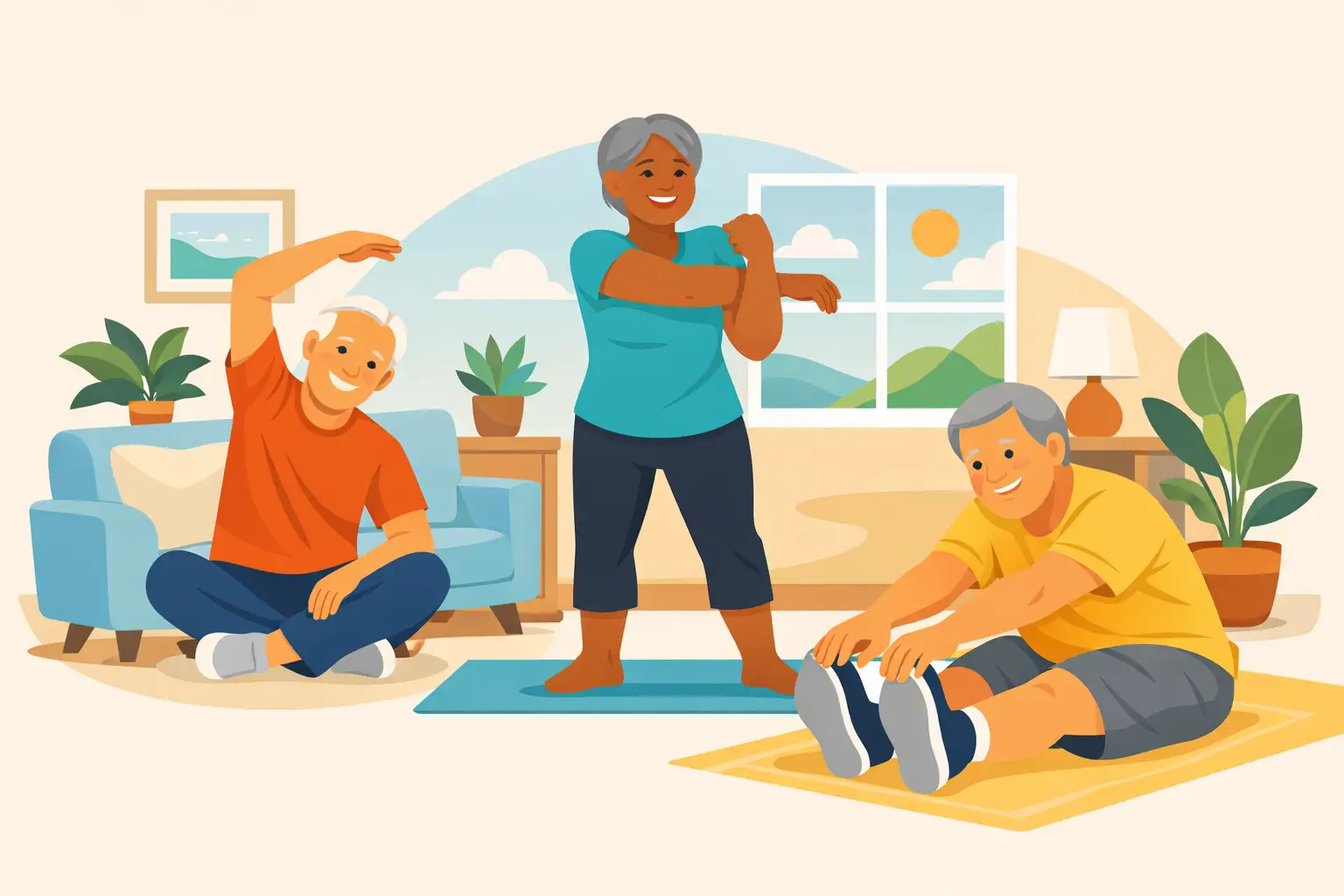
Stretching Exercises for Seniors Over 60
By Doug Jones
Stretching Exercises for Seniors Over 60: A Smart-Simple-Speedy-Safe Guide
If getting up from a chair feels like negotiating with your own knees, you are not broken. You are human. And a little regular movement can make everyday movement feel less like a major production. These stretching exercises for seniors over 60 are designed for real beginners: no gym, no floor routine, no fancy leggings, and no need to turn into a pretzel before breakfast.
Getting up from a chair should not feel like a major negotiation. The best stretching exercises for seniors over 60 are not complicated, sweaty, or reserved for people who can put a foot behind their head. They are small, steady movements that help your body keep doing ordinary, valuable things: reaching a shelf, looking over your shoulder, and walking comfortably.
Here is the good news: you do not need a gym, special clothes, or a 45-minute block. You need a safe place to stand or sit and about seven minutes of honest effort. The difference between doing nothing and next to nothing... is EVERYTHING!
Dear Doug, I've been exercising most of my life and have always performed cardio and strength training. I now realize that I should probably start stretching a lot more than I do, which is essentially zero. I always run out of time at the end of my workouts. Please help! - Jennifer A - Koloa, Kauai -
Aloha, Jennifer. We have covered a lot of information about Strength, Stamina, and Sustenance. Stretching is the vital final quadrant. This answer will be a two-parter, for starters. Mahalo for the great question — you are not alone. Most people skip stretching because they run out of time, not because they don't need it.
What Is Stretching, Really?
Stretching is the Flexibility quadrant of the Super 7 System's Four Quadrants. Strength is the foundation. Stamina is the fortitude. Stretching helps your joints move through their available range of motion. Sustenance is the fuel. You do not need an hour of any of them to get started.
I don't want to ruffle any feathers... but I have always considered Stretching to be the least important component of fitness. I have continually been amazed by just how many (and much) people emphasize it. People not only prioritize it by starting their exercise routines with Stretching, but many also dedicate their entire program to improving or maintaining joint range of motion.
Is this because it feels "easier" than everything else? Or, is it because they think that they will develop the long, lean muscles promised in the media? Don't get me wrong, stretching exercises for seniors over 60 are vitally important, but the benefits should be kept in check. In my opinion, Stretching ALONE is not enough.
The Stretching Myths That Need Stretching
Taking the contrarian perspective, one could argue that, in and of itself...
Stretching does not burn body fat.
Stretching does not prevent injuries.
Stretching does not reduce soreness.
Stretching does not increase strength.
Stretching does not reduce cholesterol.
Stretching does not improve aerobic fitness.
Stretching does not make muscles long and lean.
Stretching does not even necessarily develop flexibility.
(Yes, there ARE physiological bases for each of these points.)
Still, does this mean that you should not include stretching exercises for seniors over 60 as a part of your well-rounded fitness regimen? Of course not. You should always include Stretching after each exercise or every workout. ALWAYS! WHY?
Why You Should ALWAYS Stretch After Every Workout
1. Stretching DOES Prevent Becoming Inflexible
If you don't use it, you lose it, right? Sometimes, if you do use it, you actually lose it faster. In other words, using your muscles often... often hastens flexibility loss.
With inactivity and age, muscles gradually tighten and joint range of motion progressively decreases. Surprisingly, this muscle-shortening process is accelerated by performing the beneficial and age-defying muscular contractions of Strength and Stamina. You can lose Stretching when you use Strength and Stamina. Short, tight muscles and tendons will decrease range of motion within your body, hindering movement and limiting life. To help avoid this inevitable tightening, albeit even if only to maintain your current level of flexibility, stretching exercises for seniors over 60 should ALWAYS be performed after EACH exercise or EVERY workout.
2. Stretching DOES Facilitate Flexibility
If you do use it (Stretching), you will gain it (flexibility).
Increasing the flexibility of muscles, tendons, and joints allows you to perform Strength exercises throughout a more complete range of motion. Because muscles only get stronger within the specific range of motion in which they are worked, Stretching to an increased degree of flexibility will thereby allow your muscles to move through (and develop strength throughout) this greater range of motion, potentially indirectly helping to prevent unnecessary and unwarranted strains to the muscles and tendons.
That's a mouthful, but it basically means that stretching to develop a greater range of motion allows you the opportunity to develop Strength throughout this greater range of motion. This is a biggie!! Additionally, an increased range of motion during exercise allows your body to now burn more calories during exercise. This, along with increased metabolic musculature, results in an elevated metabolism and greater thermogenic fat-burning processes at rest.
3. Stretching DOES a Body Good
Whether performed after each exercise or every exercise session, Stretching is relaxing, reduces stress, and feels wonderful! Most people are not flexible in the least, and everybody and every body needs to do something to counteract the millions of muscular "shortening" contractions that occur throughout each hour of every day.
Smart-Safe Rules Before You Start
A stretch should feel like mild pulling or gentle tension, not sharp pain, burning, numbness, or a joint being forced into a position it plainly does not enjoy. Breathe normally. Do not bounce. Ease into a position, hold it, and ease back out.
Use a sturdy chair that will not roll or slide. Keep one hand on a counter, wall, or chair when balance is questionable. If you have had a recent surgery, fracture, replacement, fall, uncontrolled blood pressure, severe osteoporosis, or a condition affecting balance or sensation, ask your qualified health professional which movements fit you first.
You do not need to chase a big stretch. Your body is not awarding points for suffering. The useful target is a comfortable feeling of length and freedom, repeated consistently.
8 Stretching Exercises for Seniors Over 60: Your 7-Minute Daily Routine
Try this sequence once a day or on most days. It takes about seven minutes if you hold each position for 15 to 30 seconds and repeat where it feels helpful. Move slowly enough that you could carry on a conversation. These stretching exercises for seniors over 60 are seated or chair-supported so you can do them at home with no equipment.
1. Neck Turns for Looking Around Comfortably
Sit tall near the front of your chair, feet flat on the floor. Let your shoulders drop away from your ears. Slowly turn your head to look over your right shoulder, only as far as feels easy. Return to center, then turn left. Repeat three to five times per side. This is not a speed test. Imagine you are calmly checking for a parking spot, not trying to spot a mosquito in flight. If turning your head causes dizziness, pain, or tingling, stop and get individualized guidance.
2. Shoulder and Chest Opener for Desk Posture
Sit or stand tall. Gently roll both shoulders backward and down several times. Then place your hands behind your lower back if that is comfortable, or simply rest them at your sides and lightly draw your shoulder blades toward each other. Hold for 15 to 20 seconds while keeping your ribs relaxed. The goal is to open the front of the chest without arching your lower back.
3. Upper-Back Reach for Reaching Forward
Sit tall and clasp your hands together in front of you. Reach your hands forward at shoulder height as though you are gently pushing a shopping cart away. Let your upper back round slightly while your shoulders stay down. Hold for 15 to 30 seconds. You may feel this between the shoulder blades.
4. Seated Side Reach for Your Ribs and Waist
Sit with both feet planted. Rest your right hand on the chair or your thigh. Raise your left arm only as high as it comfortably goes, then lean gently to the right. Think long through the left side of your body, not collapsed over to the right. Hold, return to center, and switch sides. If raising an arm overhead bothers your shoulder, keep that hand on your hip and make the side bend smaller. Small is still movement. Small still counts.
5. Seated Hamstring Stretch for the Backs of the Legs
Sit toward the front of the chair. Extend one leg in front of you with the heel on the floor and toes pointing up. Keep a soft bend in the knee. With your back long, tip forward from your hips until you feel a mild stretch behind the thigh. Do not round your back and dive for your toes. Your toes are not going anywhere. Hold for 15 to 30 seconds, then switch legs.
6. Calf Stretch for Easier Steps
Stand facing a wall or kitchen counter. Place both hands on the support. Step one foot back, keeping that heel down and toes pointed forward. Bend the front knee slightly until you feel the stretch in the back calf. Hold for 15 to 30 seconds, then switch. Keep your body upright instead of leaning all your weight into the wall.
7. Hip Flexor Stretch for Too Much Sitting
Stand behind a sturdy chair, holding the backrest. Step one foot behind you and gently bend the front knee. Keep your chest tall and lightly squeeze the buttock of the back leg. You should feel a stretch at the front of that back hip. Hold for 15 to 20 seconds, then switch. Avoid leaning your torso forward or arching your back. If balance is a concern, make this stretch very small or skip it for now.
8. Ankle Circles for the Little Joints That Do Big Work
Sit in your chair and lift one foot just slightly off the floor. Slowly circle the ankle five times in one direction and five times in the other. Then switch feet. Your ankles help you adjust to uneven sidewalks, steps, and quick turns in the kitchen. They deserve a few seconds of attention.
How Often Should You Do These Stretching Exercises for Seniors Over 60?
For most beginners, a short daily routine is easier to remember than a long routine twice a week. Attach it to something that already happens: after brushing your teeth, while coffee brews, after a walk, or before settling into your evening chair.
Hold most stretches 15 to 30 seconds. One round is a perfectly respectable beginning. Two rounds may feel good when your body is warmed up. A useful rule: stretch after a few minutes of easy movement when possible. Walk around the house, march gently in place while holding the counter, or do a few slow sit-to-stands. Warm muscles usually respond more kindly than muscles that have been parked all day.
If one stretch consistently feels worse afterward, leave it out. Your routine should teach you to listen to your body, not argue with it. Start with the two or three movements that feel best, repeat them tomorrow, and build from there.
The 7-Second Secret: Eccentrics in Stretching
For me and my clients, it makes sense to incorporate the most scientifically-proven method, an off-center and unconventional technique for rapidly increasing muscle plasticity. You can literally watch your flexibility increase "right before your eyes." As the most productive form of flexibility training in existence, Eccentrics in Stretching is...
The strongest form of Stretching, integrating flexibility and muscle flex in every single stretch.
The fastest way to improve immediate range of motion of a joint, literally within seconds.
The most consistently recognized technique for effectively improving passive flexibility.
And, you'll read all about it... next time. Remember, flexibility is valuable, but it is only one quadrant. A body often feels more capable when stretching exercises for seniors over 60 are paired with gentle strength work and simple stamina work. Stronger legs help you use your available range of motion.
Ready to put your flexibility to work? Try SUPER 7 FREE for a Smart-Simple-Speedy-Safe daily starting point: no gym, no equipment, no downloads - just open and go.
In Health & With Hope,
Doug :-)

About the Author: Douglas Jones, BS, MA, CSCS
Douglas Jones earned his Master's Degree in Exercise Physiology from the University of Maryland and is a Certified Strength and Conditioning Specialist. As an Exercise Physiologist and Concierge Fitness Professional based in Kaua'i, he has helped thousands of clients in person and millions online build simple, science-based habits for strength, stamina, stretching, and sustenance.
Doug is the founder of the Super 7 System — a complete training system you can do at home in as little as 7 minutes a day.
Watch his free intro and start free at Super7System.com.