Upper Body Push Exercises for Seniors: Home Fitness Guide
By Doug Jones
Q: Which muscle groups do upper body push exercises target for seniors?
A: Upper body push movements focus on strengthening the chest (pectoralis), front shoulders (deltoids), and the backs of the arms (triceps) to support daily lifting and pushing tasks.
What's In This Article
- Doug's original column: PUSH Muscles
- Safe Chest Press for Older Adults
- Mastering Eccentric Pushups for Seniors
- Simple Triceps Exercises at Home Senior Workouts Require
- FAQ: the questions I get asked most
Aloha and welcome! If you want to stay strong and independent without wearing out your joints, learning how to perform **upper body push exercises for seniors** is one of the smartest habits you can build.
A reader named Billy from Moloa`a wrote in asking how to split up workouts on days when doing a full-body routine feels like a bit too much. His question touches on a principle every mature adult should know: working muscles that function together on the same day.
Below is my original column on grouping your chest, shoulders, and triceps together. By focusing on controlled motion and giving your body adequate rest, you can keep your upper body strong and healthy for years to come.
Start free at Super7System.com, or take the free fitness sampler and see the full program details.
Original Column: PUSH Muscles
Aloha Doug,
I appreciate your information and always look forward to your articles. My question might be too basic for an entire column but I’m wondering if you could tell me the best way to divide up my exercises during my strength training workouts. When I don’t feel like doing a full body workout, how should I split up the muscles? Mahalo!
Billy M, Moloa`a -
Aloha Billy,

Mahalo for your kind words and great question. No topic is too basic; in fact, I am actually going to devote my next three columns to your specific quandary.
As you learn to apply universal principles to your individualized program, don’t forget that all of my columns are archived on my website as well as that of The Garden Island Newspaper, just in case you ever feel the need to binge on my super secrets.
With regard to training the muscles, the best place to begin is with my recurring mantra: “Slowly lowering weight is the secret to strength training.” Whether you train one muscle at a time, or all at once, this single secret is the smartest, simplest, speediest, and safest scientific solution to strength. Try it! During your next workout session, during each repetition of every exercise, lower the weight at the pace of 7 seconds down. Slow down! Slow down! Slow down!
With that being said, let’s get to the question at hand. What if you don’t have the time, energy, or interest in training your full body in one workout? Which muscles and exercises should you group together?
PART ONE of my answer for you starts with UPPER BODY: PUSH muscles.
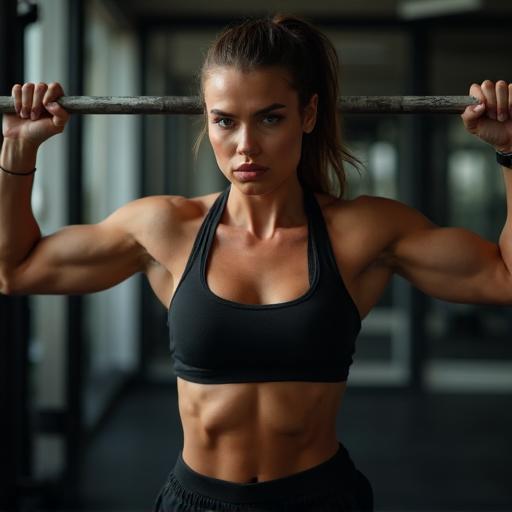
Hopefully, you remember the gist of Eccentrics in Strength: the only reason you lift weights is so you can lower weights; the only reason you lower weights is so you can stop.
Stopping weight training suggests rest, the time when your muscles can repair and recover before their next bout of exercise. If your body does not have sufficient recuperation between workouts, you will become overtrained and overtired.
One of the best ways to assure proper recovery is to “Work Muscles That Work Together, Together.” In other words, muscles that are used during similar movements should typically be trained at similar times. Likewise, muscles that are used during one workout should purposely rest during the next workout. Recovery requires rest.

Specifically, let’s take a look at your triceps, the muscle group on the back of your upper arm. The primary action of the triceps is to extend the forearm, straightening the elbow as you would during a karate chop. Thus, your triceps is contracting during any karate chop movement, regardless of the direction… up, down, forwards, backwards, or sideways.
And, please, don’t forget about Eccentrics, which works the triceps muscle in the opposite direction of the karate chop. The triceps is exercising Eccentrics (lengthening muscle under tension) when the elbow is being forced to bend and the muscle is resisting the resistance. Rather than contracting and chopping, the triceps muscle is acting eccentrically and opposing the chop. A simple example of this motion is the slowering- lowering movement during push-ups.
So, either way, chopping, or resisting the chop, you are working the triceps muscles, right?
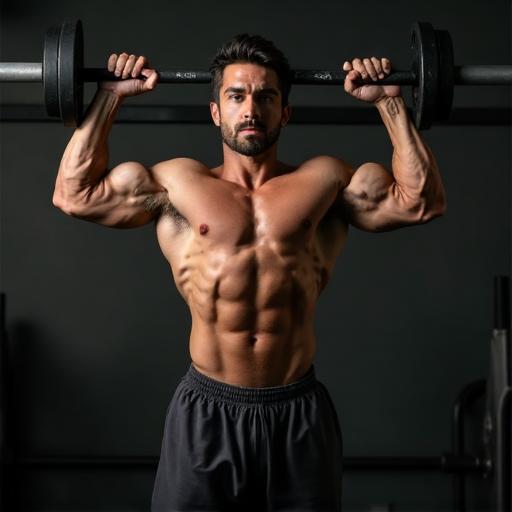
Now, let’s say that you want to train your chest muscles on Monday with push-ups; you are also training your triceps because your elbows are straightening against resistance and then resisting the bend. If, on Tuesday, you train your shoulder muscles with an overhead dumbbell press, you are, once again, also training your triceps. The triceps contract, along with the shoulders, to push the weight overhead. The triceps then act eccentrically to resist you dropping the weights on your head like a dumbbell.
Do you see where I’m going with this? You have indirectly worked your triceps on both Monday and Tuesday. What if you now want to directly train your triceps on Wednesday, by performing any type of karate chop exercise? Considering that your triceps muscles are probably already overtrained and overtired from the previous two days, the workout would be intense overkill, at best.
The point? Your chest, shoulders, and triceps are designed to work together in training… and in rest. Even if you only train one, ideally, you should always rest all.

Ideally, try to work muscles that work together (Upper Body PUSH Muscles: Chest, Shoulders, and Triceps), together (Upper Body PUSH Exercises: Push-Ups, Pec Fly, Chest Press, Lateral Raise, Overhead Press, and Triceps Extension).
Ready to put your upper-body strength to work? Try SUPER 7 FREE for a Smart-Simple-Speedy-Safe daily starting point: no gym, no equipment, no downloads - just open and go.
In Health & With Hope,
Doug :-)
Safe Chest Press for Older Adults
When selecting a chest press for older adults, our main goal is to build real-world strength in the chest and arms while keeping shoulder joints completely protected. You do not need heavy iron barbells or intimidating gym machines to get fantastic results right in your own living room.
Using light dumbbells while lying on a cushioned mat or rug gives your spine and shoulders natural floor support. As you press the weights upward, focus on a smooth, steady push. The real secret happens as you lower the weights back down toward your body. Spend a full 7 seconds slowly lowering those dumbbells. That steady resistance builds deep muscle strength without joint irritation.
If getting down onto the floor is uncomfortable, you can perform an incline chest press standing up against a solid kitchen counter or wall.
Try these safe technique guidelines this week:
- Keep your shoulder blades gently pulled back and down toward your hips.
- Do not lock your elbows out hard at the top of the motion.
- Exhale gently as you press up, and inhale slowly as you lower down over 7 seconds.
- Stop immediately if you feel any sharp discomfort in your shoulders or elbows.
Mastering Eccentric Pushups for Seniors
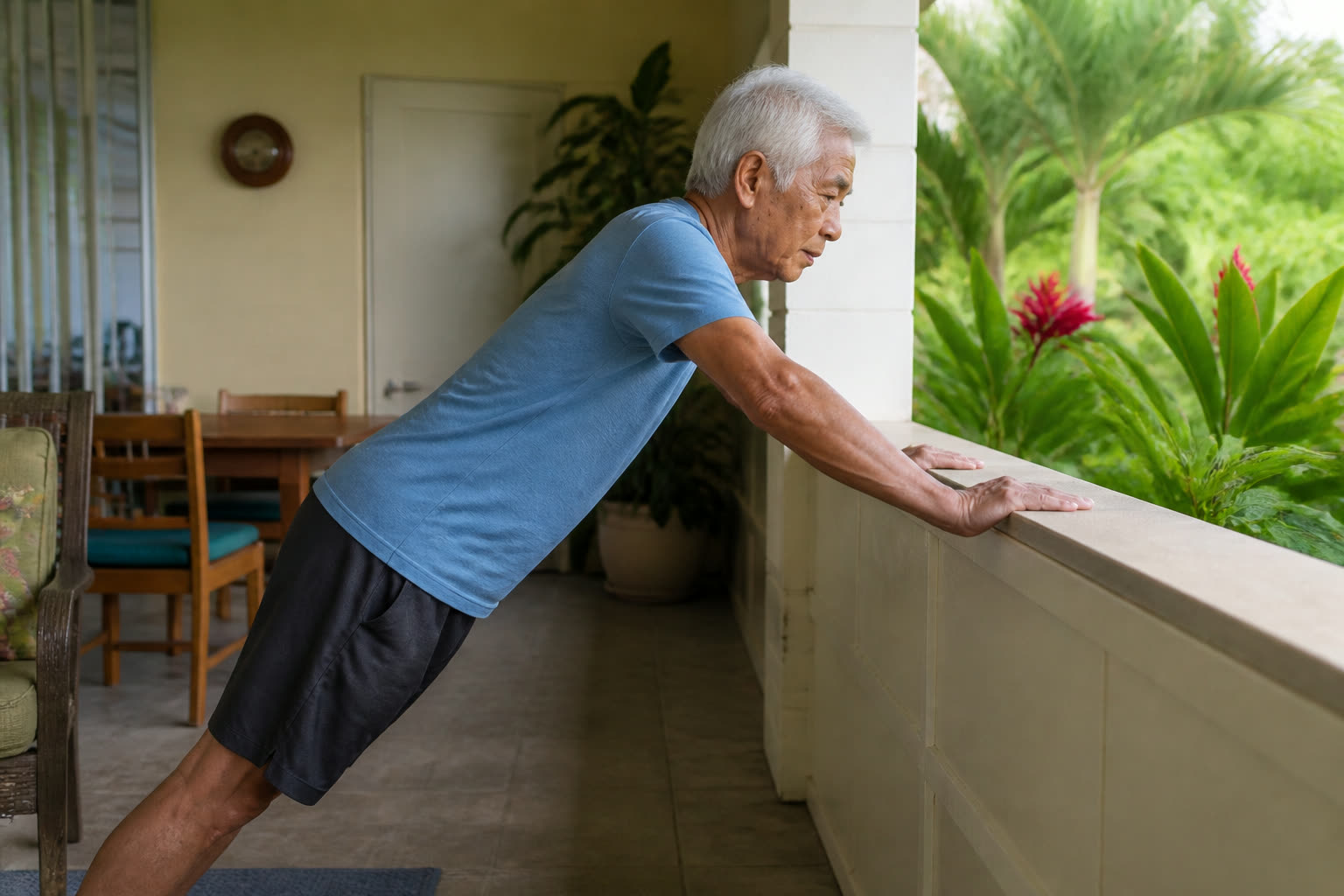
Traditional floor pushups can put excess stress on mature wrists and shoulders, but eccentric pushups for seniors offer a gentle, highly effective alternative. Eccentric training simply means focusing on the lowering phase of an exercise, where your muscles are naturally at their strongest.
Start by standing about two feet away from a sturdy kitchen counter. Place your hands flat on the edge, slightly wider than shoulder-width apart. Keeping your body straight from your ears down to your ankles, lower your chest slowly toward the counter over a deliberate 7-second count. Once your chest approaches the edge, smoothly push back up to your starting position.
If pushing back up feels like too much strain on your joints, simply walk your feet forward toward the counter to reset, step back, and practice only the 7-second lowering phase again.
Keep these practical hints in mind:
- Ensure your shoes are gripping a non-slip floor surface.
- Keep your core engaged so your hips do not sag forward.
- Aim for 5 to 8 slow repetitions per set.
- Focus entirely on smooth control rather than doing fast reps.
Simple Triceps Exercises at Home Senior Workouts Require
Your triceps sit on the back of your upper arm and do the heavy lifting whenever you push open a heavy door or push yourself up out of an armchair. Incorporating practical triceps exercises at home senior routines can easily feature helps keep your arms functional and stable without requiring special equipment.
A counter-supported triceps kickback is a wonderful starting exercise. Stand next to your kitchen counter, placing one hand on the edge for balance. Hold a very light dumbbell or water bottle in your opposite hand. Hinge slightly forward at your hips, bring your elbow up high near your ribs, and extend your arm backward until it is straight. Pause briefly, then lower the weight back down over a strict 7-second count.
Because your triceps assist during chest presses and pushups, always train them on the same day as your chest and shoulders so they get full rest afterward.
Remember these key tips:
- Keep your upper arm still and move only from the elbow joint.
- Keep your neck relaxed and aligned with your spine.
- Start with a very light weight until your form feels effortless.
- Consult your healthcare provider if you have recent elbow or shoulder concerns.
For general background, see CDC Physical Activity Guidelines for Older Adults.
FAQ: Questions I Get Asked Most
What are upper body push exercises for seniors?
Upper body push exercises for seniors are movements that target the chest, shoulders, and triceps by pushing resistance away from the body. Examples include wall pushups, counter presses, and dumbbell presses. Performing them with a slow 7-second lowering phase builds functional strength while protecting mature joints from excessive strain.
How often should older adults train push muscles?
Training your push muscles twice a week is plenty for most older adults. Because your chest, shoulders, and triceps all assist during pressing movements, grouping them into one workout allows all three muscle groups to fully rest and recover before your next session.
Are counter pushups safe for older adults with sensitive wrists?
Yes, counter pushups are much easier on sensitive wrists than floor pushups. Standing at an incline reduces the weight placed on your hands. You can also place your palms flat on the counter edge or hold onto the edge with a neutral grip to reduce wrist angle.
Why do my shoulders hurt during overhead pressing?
Shoulder discomfort often happens when pressing weights directly overhead with tight joints or heavy loads. Try pressing at a slight forward angle, using lighter weights, or substituting standing counter pushups. Always stop if you feel sharp pain, and check with your physician.

About the Author: Douglas Jones, BS, MA, CSCS
Douglas Jones earned his Master's Degree in Exercise Physiology from the University of Maryland and is a Certified Strength and Conditioning Specialist. As an Exercise Physiologist and Concierge Fitness Professional based in Kaua'i, he has helped thousands of clients in person and millions online build simple, science-based habits for strength, stamina, stretching, and sustenance.
Doug is the founder of the Super 7 System — a complete training system you can do at home in as little as 7 minutes a day.
Watch his free intro and start free at Super7System.com.
Medical disclaimer: This article is educational only and is not medical advice, diagnosis, or treatment. Stop any movement that causes pain, and check with your healthcare provider before starting new exercise or changing your diet.
Seven honest minutes at your own counter. Try Super 7 Free →