Why Stretching Matters After 60: The Truth About Flexibility
By Doug Jones
Why Stretching Matters After 60: The Truth About Flexibility
Why does stretching matter after 60?
Understanding why stretching matters after 60 comes down to preserving your freedom of movement. As muscle fibers naturally shorten and tighten from daily activity and strength exercises, gentle post-workout stretching restores full joint range of motion, keeps your body moving safely, and helps you stay active, independent, and strong!
What's In This Article
- Stretching and Flexibility: Are We Stretching the Truth?
- Why Stretching Matters After 60 for Daily Mobility
- Safe Post-Workout Stretch Routines for Golden Years
- How Stretching Enhances Your Strength Training
- The Magic of Post-Exercise Muscle Relaxation
- Why stretching matters after 60: Questions I Get Asked Most
Aloha from beautiful Kaua'i! Looking out toward Bali Hai today, I am reminded of how glorious it feels to move freely without stiff joints holding us back. Many folks ask me about fitness routines later in life, and understanding why stretching matters after 60 is a huge part of staying active on our island paradise.
While strength training and stamina work are essential, every muscle contraction actually shortens your muscle fibers! If you never stretch those tight muscles back out, your joints gradually lose their full range of motion. That makes everyday movements feel harder than they should!
I always teach a simple approach to flexibility that fits seamlessly into your daily routine. By taking just a few minutes after your walks or workouts, you preserve your mobility and safeguard your joint health. When you follow a smart fitness program for seniors, keeping your muscles long, supple, and relaxed becomes second nature.
Here is the column that started it.
Stretching and Flexibility: Are We Stretching the Truth?
Dear Doug,
I’ve been exercising most of my life and have always performed cardio and strength training. I now realize that I should probably start stretching a lot more than I do, which is essentially zero. I always run out of time at the end of my workouts. Please help!
Jennifer A.
- Koloa, Kauai -
Aloha, Jennifer. We have covered a lot of information about Strength, Stamina, and Sustenance. Stretching is the vital final quadrant. This answer will be a two-parter, for starters.
I don’t want to ruffle any feathers… but I have always considered Stretching to be the least important component of fitness. I have continually been amazed by just how many (and much) people emphasize it. People not only prioritize it by starting their exercise routines with Stretching, but many also dedicate their entire program to improving or maintaining joint range of motion.
Is this because it feels “easier” than everything else? Or, is it because they think that they will develop the long, lean muscles promised in the media? Don’t get me wrong, Stretching is vitally important, but the benefits should be kept in check. In my opinion, Stretching ALONE is not enough. Taking the contrarian perspective, one could argue that, in and of itself…
- Stretching does not burn body fat.
- Stretching does not prevent injuries.
- Stretching does not reduce soreness.
- Stretching does not increase strength.
- Stretching does not reduce cholesterol.
- Stretching does not improve aerobic fitness.
- Stretching does not make muscles long and lean.
- Stretching does not even necessarily develop flexibility.
(Yes, there are physiological bases for each of these points.)
Still, does this mean that you should not include Stretching as a part of your well-rounded fitness regimen? Of course not. You should always include Stretching after each exercise or every workout. ALWAYS! WHY?
1. Stretching DOES prevent becoming inflexible.
If you don’t use it, you lose it, right? Sometimes, if you do use it, you actually lose it faster. In other words, using your muscles often… often hastens flexibility loss.
With inactivity and age, muscles gradually tighten and joint range of motion progressively decreases. Surprisingly, this muscle-shortening process is accelerated by performing the beneficial and age-defying muscular contractions of Strength and Stamina. You can lose Stretching when you use Strength and Stamina.
Short, tight muscles and tendons will decrease range of motion within your body, hindering movement and limiting life. To help avoid this inevitable tightening, albeit even if only to maintain your current level of flexibility, Stretching should ALWAYS be performed after EACH exercise or EVERY workout.
2. Stretching DOES facilitate flexibility.
If you do use it (Stretching), you will gain it (flexibility).
Increasing the flexibility of muscles, tendons, and joints allows you to perform Strength exercises throughout a more complete range of motion. Because muscles only get stronger within the specific range of motion in which they are worked, Stretching to an increased degree of flexibility will thereby allow your muscles to move through (and develop strength throughout) this greater range of motion, potentially indirectly helping to prevent unnecessary and unwarranted strains to the muscles and tendons.
That’s a mouthful, but it basically means that Stretching to develop a greater range of motion allows you the opportunity to develop Strength throughout this greater range of motion. This is a biggie!!
Additionally, an increased range of motion during exercise allows your body to now burn more calories during exercise. This, along with increased metabolic musculature, results in an elevated metabolism and greater thermogenic fat-burning processes at rest. The benefits of Stretching to benefit Strength are huge!

3. Stretching DOES a body good.
Whether performed after each exercise or every exercise session, Stretching is relaxing, reduces stress, and feels wonderful! Most people are not flexible in the least, and everybody and every body needs to do something to counteract the millions of muscular “shortening” contractions that occur throughout each hour of every day.
For me, and my clients, it makes sense to incorporate the most scientifically-proven method, an off-center and unconventional technique for rapidly increasing muscle plasticity. You can literally watch your flexibility increase “right before your eyes.” As the most productive form of flexibility training in existence, Eccentrics in Stretching is…
- The strongest form of Stretching, integrating flexibility and muscle flex in every single stretch.
- The fastest way to improve immediate range of motion of a joint, literally within seconds.
- The most consistently recognized technique for effectively improving passive flexibility.
And, you’ll read all about it… next time.
Why Stretching Matters After 60 for Daily Mobility
When you perform strength training or enjoy a brisk walk along the beach, your muscles contract thousands of times. That is fantastic for your heart and bones! However, those repeated contractions shorten your muscle tissue over time. That is exactly why stretching matters after 60 so much—it reverses that natural shortening process.
Without stretching, short and tight muscles pull on your joints. This limits your range of motion and makes simple daily actions—like reaching into a top cupboard or tying your shoes—feel like a chore! By stretching right after your exercise sessions, you reset muscle length while the tissue is warm and pliable.
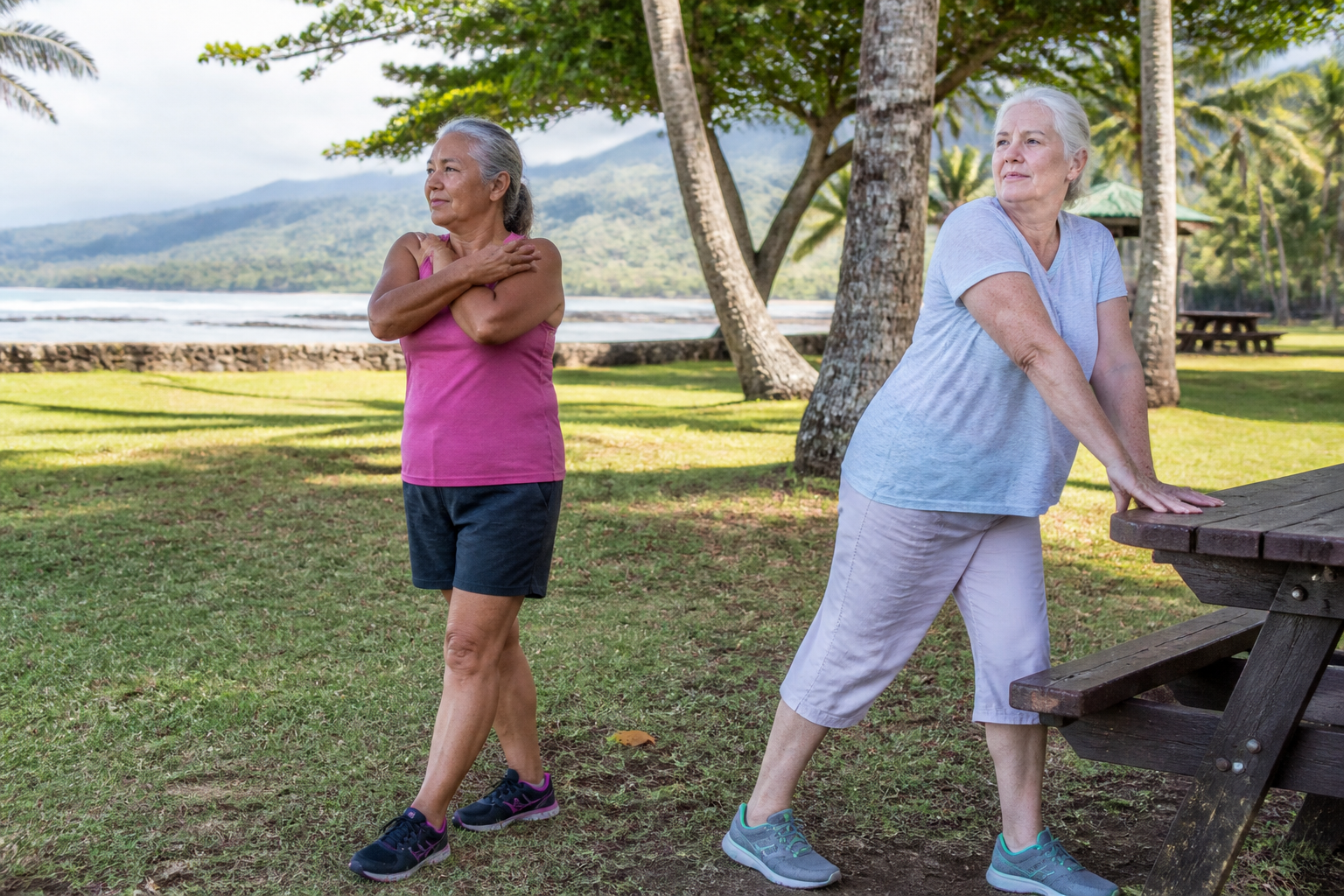
Always keep safety first! You do not need extreme poses or complicated routines on the floor. Standing tall with one hand gently resting on a sturdy kitchen counter or wall for support gives you absolute stability while you stretch out your calves, hamstrings, and chest muscles safely.
Safe Post-Workout Stretch Routines for Golden Years
To get the most out of your flexibility training, stick to simple, safe movements that do not threaten your balance. The difference between doing nothing and next to nothing... is EVERYTHING! You do not need to spend hours stretching to reap big rewards.
Smart-Simple-Speedy-Safe Standing Stretches
- Calf Stretch at the Counter: Stand facing a counter with your hands resting lightly on the surface. Step one foot back, keep your heel flat on the floor, and gently bend your front knee until you feel a comfortable stretch in your back calf.
- Standing Chest Stretch: Place one hand flat against a wall at shoulder height. Gently turn your body away until you feel a light, relaxing opening across your chest and front shoulder.
- Gentle Quadriceps Stretch: Stand tall next to a sturdy wall for balance. Lightly bend your knee to bring your heel slightly backward, keeping your knees aligned without straining your joint.
Hold each gentle stretch for 15 to 30 seconds. Never bounce! Smooth, steady breathing helps your nervous system relax, allowing the muscle fibers to release tension smoothly.
How Stretching Enhances Your Strength Training
Flexibility and strength go hand in hand. Muscles only gain strength throughout the specific range of motion in which you train them. If your muscles are tight and restricted, your strength exercises cover a much smaller path, limiting your gains!
When you expand your joint range of motion through regular stretching, you allow your muscles to work through a fuller distance during strength movements like wall push-ups. This fuller motion engages more muscle fibers, elevates your metabolism, and helps your body burn calories more efficiently throughout the day.
Integrating flexibility into a comprehensive routine designed for active adults ensures that your muscles stay both strong and supple. Remember, knowing why stretching matters after 60 allows YOU!!! to make informed, empowered choices every single day!
The Magic of Post-Exercise Muscle Relaxation
Beyond joint health and muscle length, stretching feels incredible! Finishing an exercise session with light flexibility work signals to your nervous system that the hard work is done. It reduces stress, lowers tension, and promotes deep physical relaxation.
When done consistently after exercise, stretching helps preserve your physical independence so you can enjoy walking, gardening, and playing with grandkids without unnecessary stiffness. Keep it simple, keep it safe, and celebrate every small bit of progress you make!
Mahalo for investing in your health and taking care of the wonderful body you have!
Why stretching matters after 60: Questions I Get Asked Most
Should older adults stretch every day?
While you do not need long daily sessions, doing gentle stretches after every exercise routine or brisk walk is ideal! It helps maintain joint flexibility and prevents muscle tightness. Always make sure your muscles are warm before stretching, and keep a hand on a wall or counter for support!
Is it better to stretch before or after exercise?
It is always safest and most effective to stretch AFTER your workout when your muscles are warm and pliable. Stretching cold muscles can cause strain, whereas post-workout stretching restores muscle length shortened during exercise contractions!
Can stretching improve balance after age 60?
Yes! Stretching improves your joint range of motion in your ankles, knees, and hips, which allows your body to make subtle balance adjustments more easily. Always perform your standing stretches while holding onto a steady counter or wall for support!
How long should you hold a stretch?
Hold each stretch gently for 15 to 30 seconds without bouncing. Breathe deeply and smoothly while holding the position. If you feel any sharp pain, back off immediately—stretching should feel like a mild, relaxing tension release!
Ready to put this to work today? Try SUPER 7 FREE for a Smart-Simple-Speedy-Safe daily starting point: no gym, no equipment, no downloads - just open and go.
In Health & With Hope,
Doug :-)

About the Author: Douglas Jones, BS, MA, CSCS
Douglas Jones earned his Master's Degree in Exercise Physiology from the University of Maryland and is a Certified Strength and Conditioning Specialist. As an Exercise Physiologist and Concierge Fitness Professional based in Kaua'i, he has helped thousands of clients in person and millions online build simple, science-based habits for strength, stamina, stretching, and sustenance.
Doug is the founder of the Super 7 System — a complete training system you can do at home in as little as 7 minutes a day.
Watch his free intro and start free at Super7System.com.